Custom Server Racks for AI Workloads: What Your Deployment Needs
AI server racks must support weights ranging from ~2,500 to 3,500+ lbs (1,100-1,600 kg) — roughly 3× the load of traditional 1U/2U server racks. Key requirements: (1) load rating of 2,500+ lbs static, (2) reinforced base plates and heavy-duty casters, (3) extended depth (48″+ for liquid-cooled systems), (4) integrated cable management for high-density power and fiber, and (5) seismic-rated anchoring. Nearshore fabrication in Mexico avoids tariff exposure on Chinese imports.
Why AI has broken traditional rack specifications
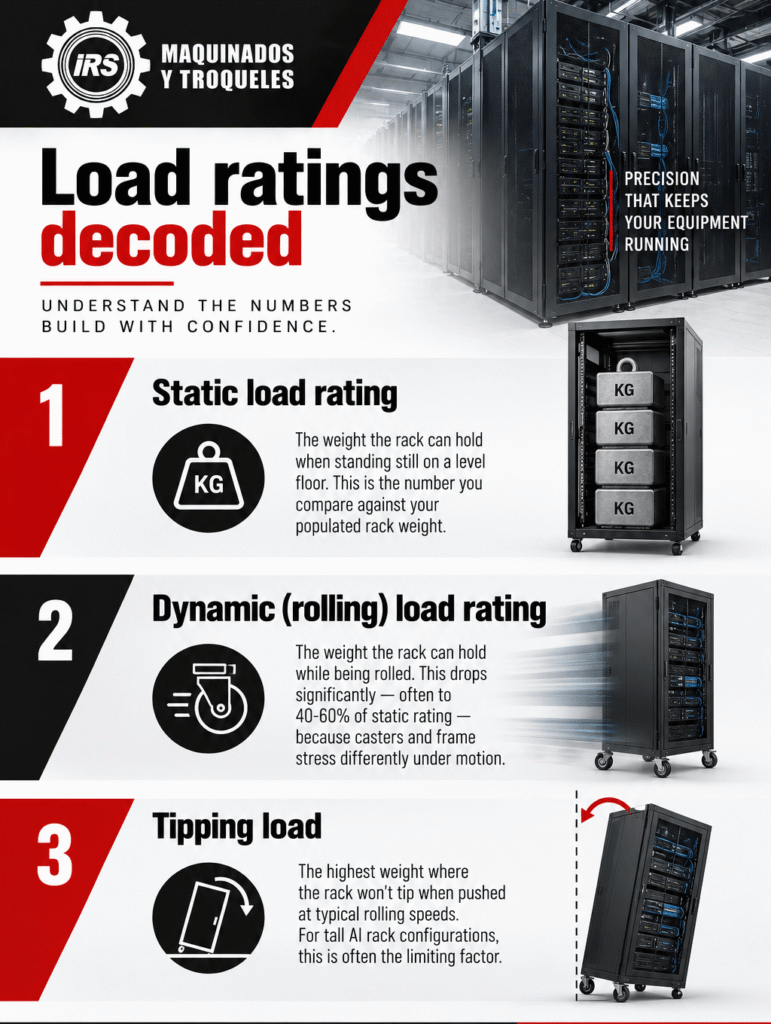
A traditional server rack was designed for a world where the heaviest deployment was a fully-populated 42U cabinet of 1U or 2U servers — around 800-1,200 lbs total. Rack manufacturers rated their frames for static loads of 1,500-2,000 lbs and never had to worry about dynamic tipping loads because no one was rolling racks that heavy across a raised floor.
AI training changed all of that. NVIDIA’s DGX H100 system, per the manufacturer’s official spec sheet, weighs approximately 287 lbs (130 kg) per unit. A rack of eight DGX systems, plus networking gear, plus liquid cooling manifolds, plus power distribution, easily reaches 2,800-3,200 lbs. NVIDIA’s newer GB200 NVL72 reference architecture weighs approximately 3,000 lbs (1,360 kg) fully populated. These are numbers no off-the-shelf rack from a few years ago was engineered to hold.
For colocation operators and hyperscalers deploying AI capacity, that means many existing racks — and many existing raised floors — need to be reinforced or replaced. And when designing new AI capacity, the rack specification becomes a structural decision, not just a mechanical one.
The tariff argument: why fabricate racks in Mexico?
US tariffs on Chinese-manufactured industrial goods have ranged from approximately 25% up to 145% depending on category and moment. Racks manufactured in Mexico ship under USMCA rules of origin, which means qualifying goods enter the US duty-free. Combined with 2-3 day overland delivery to Texas data center markets, Mexico has become the practical alternative to Asian sourcing for structural rack fabrication.

What weight does an AI server rack need to support?
| For general AI/GPU workloads, target racks rated for at least 2,500 lbs (1,130 kg) static load. For reference deployments like NVIDIA GB200 NVL72, target 3,500+ lbs (1,590+ kg) static load with dynamic load ratings of 2,000+ lbs during movement. Racks below 2,000 lbs static rating will not safely hold modern AI configurations. |
Structural requirements for AI-density racks
- Frame construction
Traditional server racks use 12- or 14-gauge steel frames. AI-density racks require heavier gauge material — typically 10-gauge or thicker steel, or reinforced 12-gauge with welded gussets at load-bearing joints. Fully welded frames outperform bolted-corner assemblies for high loads because bolted joints can shift under sustained heavy load, leading to alignment issues and door binding.
- Base plate and load distribution
The base plate distributes weight to the raised floor or slab below. AI-density racks concentrate enough pressure at the base to punch through poorly-supported raised floor tiles. Reinforced base plates, wider footprints, and dedicated floor-tile reinforcement or slab-mount adapters are common in AI deployments.
- Casters and leveling feet
Standard rack casters rated at 500-800 lbs each are inadequate for AI racks. Look for casters rated at 1,000 lbs or more each (four casters × 1,000 lbs = 4,000 lbs static). Once positioned, load transfers to leveling feet, which must also carry the full weight — typically requiring 4-point leveling with hardened steel pads.
- Extended depth for liquid cooling
Air-cooled AI racks fit in traditional 42″-47″ depths. Liquid-cooled AI racks — increasingly the standard for GPU deployments over 40 kW per rack — need 48″-55″ of depth to accommodate cooling distribution units, manifolds, drip pans, and the extra plumbing behind the servers. Building depth into the rack, rather than retrofitting, saves 20-30% on total cabinet cost per industry estimates.
Power and cable density: what has changed?
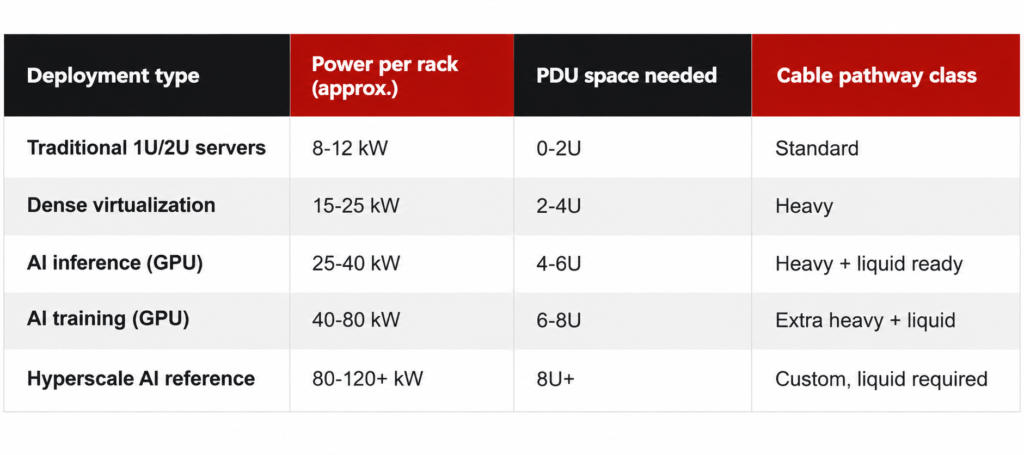
| AI racks require dramatically more power per rack than traditional deployments — often several times more. That means larger busway drops, dual-feed redundancy per rack, and integrated PDU space of 8U or more inside the rack. Cable management structures must accommodate 3-4× the fiber count of traditional deployments. |
Power density by deployment type (industry estimates)

Seismic considerations for AI racks
The IBC (International Building Code) requires seismic anchoring for equipment above certain weight thresholds, especially in seismic zones. AI racks — heavier than any category the code contemplated when first written — trigger anchoring requirements in most US jurisdictions. Custom seismic bracing engineered to the specific rack weight and seismic zone is not optional in California, Washington, Oregon, or Utah data center construction. Even in low-seismic zones like Texas, best practice is to anchor AI racks against tipping loads.
When off-the-shelf isn’t enough: custom rack fabrication
For hyperscale and specialized AI deployments, off-the-shelf racks often fail one or more requirements: insufficient depth for liquid cooling, inadequate load rating, or a footprint that doesn’t fit the aisle layout. Custom-fabricated racks solve these constraints:
- Custom depths, widths, and heights matched to the specific server hardware.
- Reinforced structural steel welded frames rated for 3,500+ lbs static load.
- Integrated seismic bracing and floor-tile reinforcement.
- Pre-engineered cable pathways and PDU cutouts to reduce field labor.
- Powder-coated finish matched to the facility color scheme.
Frequently asked questions
How much does a rack for AI workloads weigh empty?
Reinforced AI-ready racks typically weigh 300-500 lbs empty, roughly 2× a traditional 42U rack. The extra weight comes from heavier gauge steel, welded (vs. bolted) joints, and reinforced base plates.
Can I retrofit an existing rack to hold AI equipment?
Sometimes. If the existing rack is rated for 2,000+ lbs static, a retrofit with reinforced base plate, upgraded casters, and additional seismic bracing may work for lighter AI configurations. For NVIDIA GB200-class deployments, retrofit is rarely sufficient — new custom-fabricated racks are the norm.
What is the depth requirement for GPU racks?
For air-cooled GPU deployments: 42″-47″ depth is typical. For liquid-cooled or high-density GPU: 48″-55″ depth accommodates cooling distribution manifolds and back-of-rack piping. NVIDIA reference designs for liquid-cooled AI racks specify 47.24″ (1,200 mm) depth minimum per published designs.
Do AI racks require different cable management than traditional racks?
Yes. AI racks route several times the fiber count of traditional deployments, plus liquid cooling supply and return lines. Integrated vertical cable managers with expanded capacity, top-of-rack or bottom-of-rack fiber trays, and separate pathways for power vs. data are standard requirements.