Why US Data Centers Are Moving Infrastructure Manufacturing to Mexico
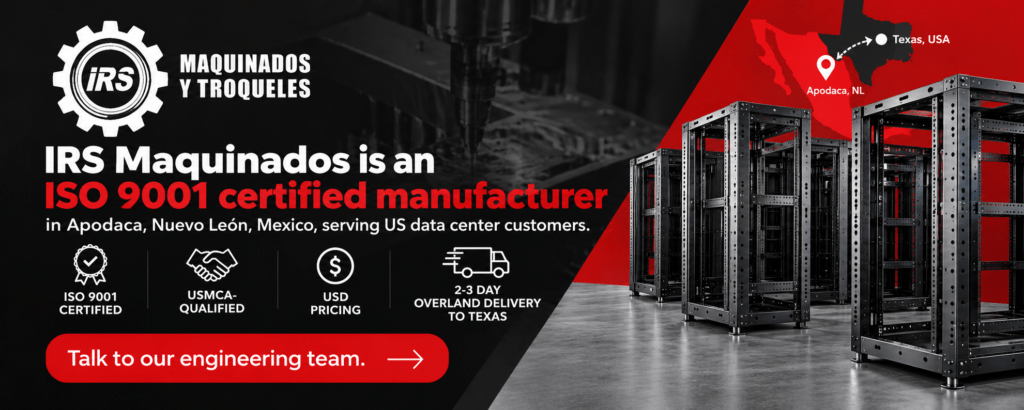
Nearshoring data center infrastructure manufacturing to Mexico delivers three structural advantages over Asian sourcing: (1) USMCA tariff-free treatment, versus US tariffs on Chinese-manufactured industrial goods that can range from ~25% up to 145% by category; (2) overland freight to Texas in 2-3 days vs. 20-30 days by sea from Asia; and (3) engineering collaboration in US Central Time. Best-fit for structural fabrication, welded assemblies, and refurbish services.
Why the data center supply chain is moving to Mexico
For two decades, the US data center supply chain grew comfortable with Asian manufacturing, particularly for structural components, cabinets, cable trays, and mid-tier hardware. Sea freight from China, Taiwan, and Vietnam cost less than domestic manufacturing. Lead times of 8-12 weeks were tolerable when growth was linear and demand was predictable.
AI has broken every assumption in that model. Demand has moved from linear to exponential. Lead times of 8-12 weeks are now business-critical bottlenecks. And tariff volatility has made total landed cost from Asia unpredictable in a way it was not five years ago. In parallel, USMCA — signed 2020 — has quietly matured into one of the most stable trade frameworks in the world for manufacturing between the US, Mexico, and Canada.
The result: US data center operators, integrators, and construction contractors are actively restructuring their supply chains to include Mexican manufacturing partners — especially for structural fabrication, welded steel assemblies, and refurbish services where the cost/quality/risk equation now clearly favors Mexico.
The tariff argument in one paragraph
US tariff policy on Chinese-manufactured goods has shifted repeatedly since 2018, with cumulative rates on many industrial categories reaching well above 25% and — for some product classifications — exceeding 100%. Mexico ships under USMCA rules of origin: qualifying goods enter the US duty-free. For structural fabrication manufactured in Mexico from North American materials, USMCA qualification is generally straightforward and the tariff-free treatment is essentially automatic.
What data center components are best-fit for Mexico nearshoring?
Mexico nearshoring is strongest for: (1) structural steel fabrication (cable trays, racks, aisle containment, seismic bracing, PDU frames), (2) welded assemblies (skids for chillers, generators, and UPS), and (3) mechanical refurbish (chiller shafts, AHU rotors, pump components). It is not yet mature for cold plates, busbars, or precision copper components — those remain in specialized Asian and US shops.
Where Mexico manufacturing shines
- Structural fabrication: carbon steel and aluminum welded assemblies at commercial rates that can materially reduce total landed cost.
- Custom mechanical assemblies: custom-fabricated racks, skids, and aisle containment systems in significantly shorter timelines than offshore sourcing.
- Refurbish services: specialized shops with vertical lathes and large-format CNC handle chiller and AHU component rebuild at a fraction of new-unit price.
- Assembly line tooling: fixtures and jigs for data center hardware assembly lines, based on decades of automotive nearshoring know-how.
Where Mexico manufacturing is not (yet) the right fit
- Cold plates and liquid cooling manifolds: require specialized copper machining and cleanroom processes not widely available in Mexican shops today.
- Busbars: high-purity copper bar with precision punching and forming — a niche capability.
- On-site electrical installation: cannot be practically nearshored — physical labor is on-site.
The savings argument (without over-promising)
Every project is different, and every quote depends on scope, materials, and current market conditions. Rather than promise specific savings percentages, this guide focuses on what is structural and verifiable:
- Tariff exposure eliminated: duty-free treatment on USMCA-qualifying goods vs. variable and often significant tariffs on Chinese imports.
- Freight timeline compressed: 2-3 day overland from Nuevo León to Texas vs. 20-30+ days sea freight plus customs from Asia.
- Time-zone alignment: US Central Time engineering and commercial teams vs. 12-14 hour lag with Asian partners.
- Currency and trade stability: USD pricing, USMCA-eligible, versus tariff-adjusted quotes from Chinese suppliers that can shift week to week.
The composite effect — tariff savings + freight savings + engineering agility — is often material, but the exact percentage depends on the specific project. We recommend requesting quotes for a bounded first project to see the numbers on your own scope of work.
USMCA: what buyers need to know
The US-Mexico-Canada Agreement (USMCA) replaced NAFTA in July 2020. For data center infrastructure manufactured in Mexico and sold into the US, USMCA delivers three specific benefits:
- Tariff-free treatment for qualifying goods
Goods manufactured in Mexico that meet the USMCA rules of origin — typically requiring substantial North American content and transformation — enter the US free of tariffs. For structural steel fabrication using North American steel and Mexican labor, qualification is straightforward.
- Predictable customs clearance
USMCA established Trusted Trader programs (C-TPAT on the US side, NEEC on the Mexican side) that streamline border crossing. For truckloads of structural components, cleared customs typically add only a few hours to a 24-hour transit time — provided the manufacturer has proper documentation.
- Trade stability
Unlike tariffs on Chinese imports — which have shifted repeatedly since 2018 — USMCA is a treaty with 16-year renewal cycles. For capital planning of data center buildouts spanning 24-36 months, trade stability is real value.
How to qualify a Mexican manufacturing partner
Not every Mexican shop is data-center-ready. A qualification framework helps you separate serious partners from unproven ones. Each project should be evaluated based on your specific scope, timeline, and quality requirements.
Level 1: table stakes (baseline requirements)
- ISO 9001:2015 certification current, ideally 3+ years running.
- Documented quality system with First Article Inspection procedures.
- Material traceability with Mill Test Reports (MTRs) available.
- USMCA certificate of origin documentation on demand.
- References from US customers in industrial or automotive sectors.
Level 2: technical capacity
- Large-format CNC machining for structural components.
- Vertical turning capacity for refurbish work.
- Certified welding processes (MIG, TIG, SMAW) with certified welders.
- CMM validation with a Faro arm or equivalent.
- Overhead crane capacity for heavy assemblies.
Level 3: data-center-specific readiness
- Experience with tight-tolerance mechanical components.
- Documented deliveries to automotive Tier 1 or aerospace clients (proxy for quality culture).
- Ability to deliver full documentation packages (FAI, MTRs, CoC, traceability).
- Understanding of data center delivery windows and just-in-time constraints.
Frequently asked questions
Are there tariffs on data center components from Mexico?
Not for USMCA-qualifying goods. Products manufactured in Mexico from qualifying materials enter the US free of tariffs under USMCA rules of origin. The manufacturer provides a certificate of origin that documents qualification.
How long does it take to ship from Mexico to a US data center?
Overland freight from Nuevo León, Mexico to Texas: typically 2-3 days transit including customs. To the US Southeast (Georgia, Virginia): typically 3-5 days. To California: 3-4 days. Compare to sea freight from Asia, which typically takes 20-30 days plus customs.
Do Mexican manufacturers deliver quality equivalent to US shops?
Yes — for shops with ISO 9001 certification, documented quality systems, and experience with Tier 1 automotive or aerospace customers. Nuevo León in particular has a manufacturing base built by 30+ years of automotive nearshoring, delivering the quality culture that data centers require.
What’s the language barrier like?
For qualified export-focused manufacturers, engineering and commercial teams are English-fluent. Drawings, quotes, and documentation come in English. On-the-floor communication happens in Spanish, but the customer-facing interface is entirely in English.