When Should You Refurbish a Data Center Chiller Instead of Replacing It?
Refurbishing a data center chiller in Mexico typically costs a fraction of buying new — industry estimates put refurbish at roughly 30-40% of new-unit price — and delivery is measured in weeks, not months. Refurbish is the right call when the compressor and heat exchanger are sound and the failure is limited to shafts, bearings, seals, or impellers. Nearshore manufacturing in Nuevo León adds USMCA tariff-free treatment and 2-3 day overland delivery to Texas.
Why refurbish decisions matter more in 2026
The math on chiller refurbish vs. replacement has shifted for two reasons. First, AI training clusters have pushed rack densities well past legacy design specs — Uptime Institute survey data shows average rack density has climbed from single-digit kW ranges toward 30-50+ kW for GPU workloads. Second, OEM lead times for new chillers have stretched significantly as demand outpaces production, with buyers reporting 16-24 week lead times or longer for large centrifugal units.
Add to that the US-China trade dynamics: with tariffs on Chinese-manufactured cooling equipment running from roughly 25% up to 145% depending on the category, buyers are actively seeking alternative supply chains. Nearshore manufacturing in Mexico — where USMCA delivers tariff-free treatment for qualifying goods — has become the practical answer.

What is chiller refurbish?
Chiller refurbish is the mechanical restoration of a chiller’s rotating and sealing components — shafts, rotors, bearings, seals, impellers, and coupling faces — to original spec, while keeping the compressor housing, condenser, and heat exchanger in place. It typically extends useful life several years at a fraction of new-unit cost.
A proper refurbish is not a repair. Repair fixes a specific failure. Refurbish restores dimensional tolerances across all worn surfaces so the unit runs as if it were new. This distinction matters for reliability: a repaired chiller may run for months before another component fails; a refurbished chiller starts a new lifecycle.
The four components that drive refurbish decisions
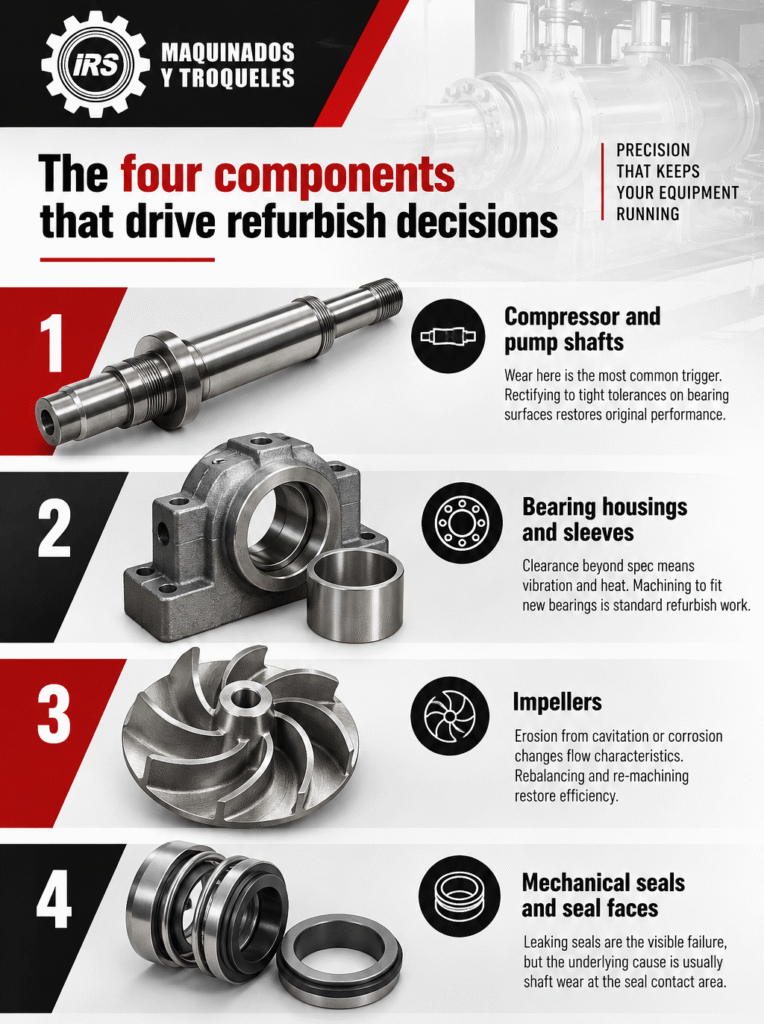
- Compressor and pump shafts: wear here is the most common trigger. Rectifying to tight tolerances on bearing surfaces restores original performance.
- Bearing housings and sleeves: clearance beyond spec means vibration and heat. Machining to fit new bearings is standard refurbish work.
- Impellers: erosion from cavitation or corrosion changes flow characteristics. Rebalancing and re-machining restore efficiency.
- Mechanical seals and seal faces: leaking seals are the visible failure, but the underlying cause is usually shaft wear at the seal contact area.
When should you refurbish a chiller instead of replacing it?
Refurbish is the right choice when: (1) the compressor and heat exchanger are sound, (2) the chiller is under 15 years old and uses a modern refrigerant, (3) OEM parts have long lead times, and (4) you need the unit back in service faster than new-unit availability. Replace when the chiller is at end-of-life or when refrigerant regulations force it out.
The 6-point refurbish checklist
If you can answer YES to five of these six questions, refurbish is likely the right path:
- Is the chiller under 15 years old?
- Is the compressor mechanically sound (no scoring in the cylinders, no bearing seizure)?
- Are the heat exchanger tubes free of major fouling and corrosion?
- Does the unit use a refrigerant that is still legally supported (not R-22, not phased-out HFCs)?
- Is OEM lead time longer than the downtime you can absorb?
- Do you need the unit in service faster than a new unit can be delivered?
When replacement is the smarter path
If any of these apply, replacement (or emergency lease) is usually better:
- The compressor cylinders are scored or the housing is cracked.
- Heat exchanger tubes are corroded through or have multiple leaks.
- The unit uses R-22 or another phased-out refrigerant.
- You’re planning a facility expansion where new capacity is needed anyway.
- Total refurbish quote exceeds ~60% of a new-unit price.
Why do refurbish in Mexico? The tariff and logistics argument
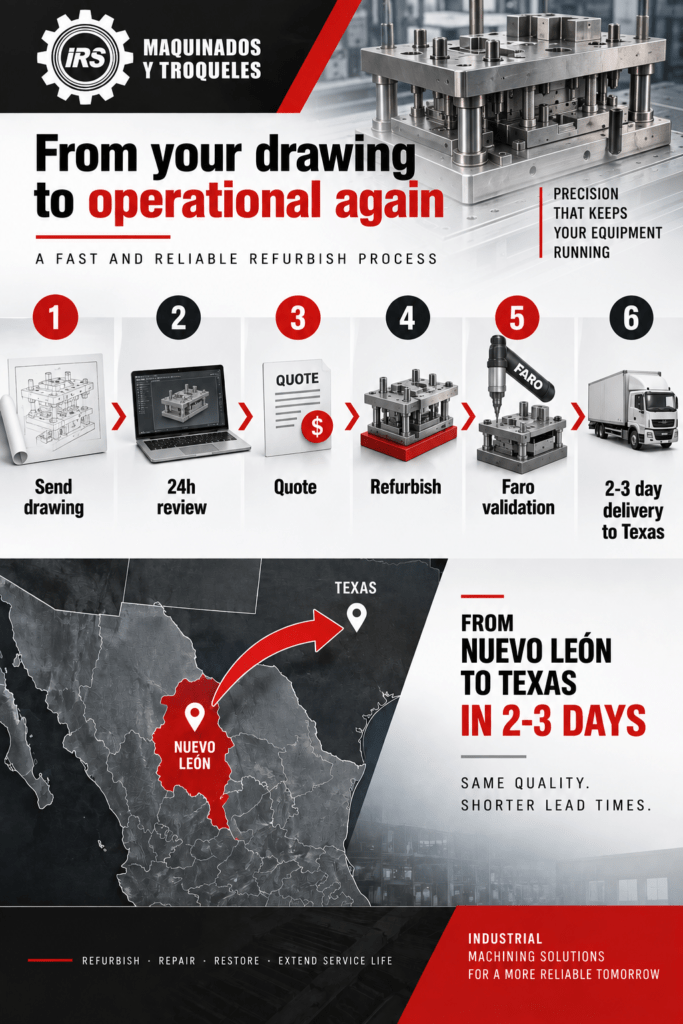
Nearshoring chiller refurbish to Mexico delivers three structural advantages over Asia: (1) USMCA tariff-free treatment vs. tariffs on Chinese imports that can range from ~25% up to 145%; (2) overland freight from Nuevo León to Texas in 2-3 days vs. 20-30 days by sea from Asia; and (3) engineering collaboration in US Central Time — same-day drawing revisions and quality escalations.
The tariff argument in one paragraph
Between mid-2018 and 2025, US tariff policy on Chinese manufactured goods has moved from single-digit rates to double-digit and triple-digit rates across many industrial categories. The exact rate varies by product classification and can change on short notice. Mexico, by contrast, ships under USMCA — goods that meet the rules of origin enter the US duty-free. For a mechanical refurbish delivered from Mexico with North American materials, the tariff-free treatment is essentially automatic. That difference alone — before considering freight or engineering benefits — often moves the total landed cost decisively in Mexico’s favor.
The logistics argument
Apodaca, Nuevo León is roughly 3 hours by truck from the Laredo border crossing — the busiest inland port in North America. From Laredo, most Texas data center markets (Dallas-Fort Worth, San Antonio, Austin, Houston) are 4-8 hours further. The Southeast US (Georgia, Virginia) is reachable in 3-5 days total. The California and Arizona markets are 3-4 days. Compare that to sea freight from Asia — 20-30 days plus customs — and the operational difference is real, particularly for emergency refurbish.
Which chiller components can actually be refurbished?
Not everything on a chiller is a candidate for machining refurbish. Understanding the boundaries helps you scope the conversation with your refurbish partner.
Components that ARE candidates
- Main shafts and rotors (rectified on large vertical lathes).
- Bearing housings (bored and re-machined for new bearings).
- Impellers (rebalanced, re-machined; replaced if erosion is severe).
- Coupling halves and coupling faces.
- Sealing surfaces on the shaft and housing.
- Motor mounting frames and structural components.
Components that are NOT candidates for machining refurbish
- Compressor internals with scored cylinders (require full compressor replacement).
- Heat exchanger tubes (either cleaned/re-tubed or the shell replaced).
- Electronic controls and sensors (replaced from OEM stock or aftermarket).
- Refrigerant charge (recovered, filtered, or replaced).
- Insulation on cold surfaces (removed and replaced).
What documentation should you get with a refurbished chiller?
Aproperly refurbished chiller should ship with: (1) pre-refurbish inspection report with photos, (2) dimensional inspection report post-machining (CMM-validated), (3) balance certification for rotating assemblies, (4) list of parts replaced with certificates of origin, and (5) warranty covering the refurbished components. Anything less is a repair, not a refurbish.
Frequently asked questions
How long does a refurbished chiller last?
A properly refurbished chiller typically runs several additional years before another major service is needed. When the refurbish covers all rotating and sealing components (not just the failed one), reliability approaches that of a new unit for the first several years.
Can any machine shop in Mexico refurbish a data center chiller?
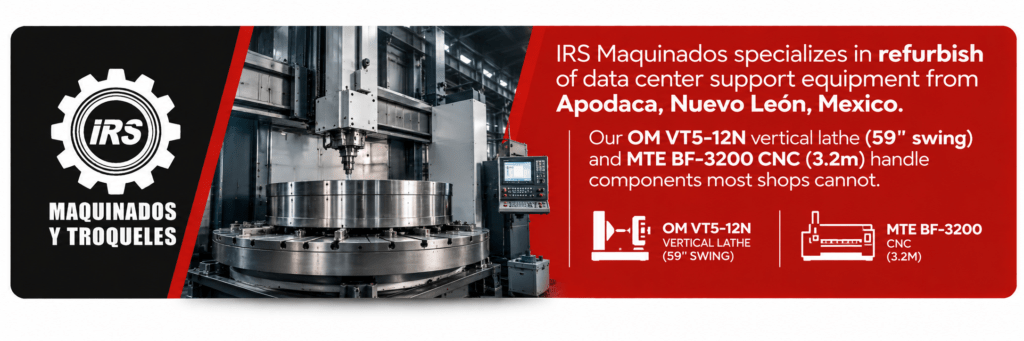
No. Chiller refurbish requires (1) large-capacity vertical turning equipment (turning height above 40 inches for medium chillers, 60+ inches for large centrifugals), (2) precision measurement with a Faro arm or equivalent CMM, and (3) welding capabilities for structural repairs. Look for an ISO 9001 certified shop in Nuevo León or nearby industrial hubs with a proven track record.
Do you need to send the chiller to Mexico, or can they come on-site?
For rotating components (shafts, rotors, impellers), the parts must be sent to a shop with the right machining equipment — on-site work is not practical. For inspection, disassembly consultation, and reassembly, an engineer can travel to your facility. Overland transit of a shaft from a US data center to Nuevo León and back is typically a few days each way.
Is refurbish worth it for a chiller that’s been in service 20+ years?
Usually no. Chillers over 20 years old often use refrigerants that are being phased out, and even after mechanical refurbish, they run less efficient than modern equivalents. Replacement with a modern high-efficiency unit typically pays back the price difference in a few years through reduced energy consumption.