Ladder vs. Wire Mesh vs. Solid Bottom: Choosing a Cable Tray Type
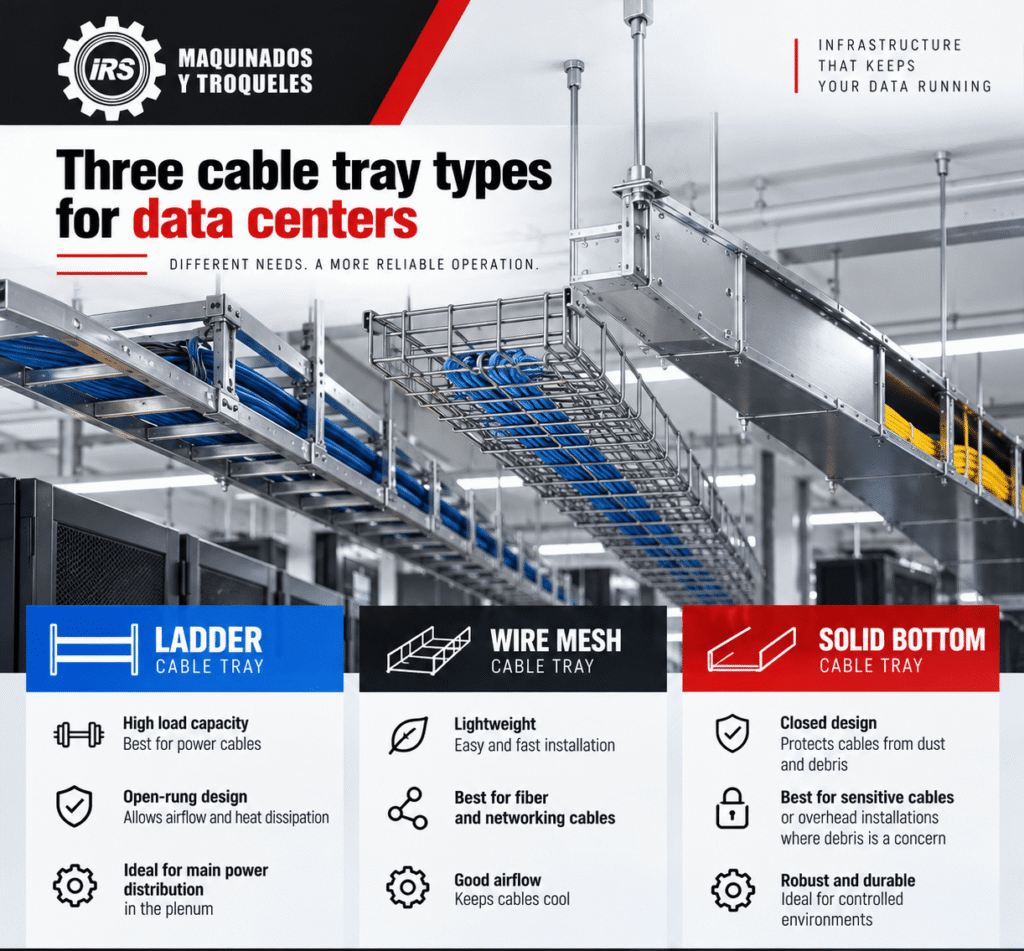
Data centers use three cable tray types: ladder (open-rung, heavy load capacity, best for power cables), wire mesh (lightweight, fast install, best for fiber and networking), and solid bottom (closed, best for sensitive cables or overhead installations where debris is a concern). Most modern data centers combine wire mesh in white space with ladder in the plenum for power distribution. Custom fabrication in Mexico avoids tariff exposure on Chinese imports.
What is a cable tray?
A cable tray is a structural support system that carries and routes cables through a facility — power cables, data cables, fiber optic runs, and control wiring. In a data center, cable trays form the physical backbone of the electrical and communications infrastructure, connecting server rows to power distribution units, network cores, and the outside plant.
The choice of cable tray type is one of the earliest design decisions in a data center buildout — and one of the most impactful on total cost, installation time, and future flexibility.
Ladder cable tray: the workhorse for power
What is ladder cable tray?
Ladder cable tray consists of two parallel side rails connected by evenly-spaced perpendicular rungs, forming a ladder-like structure. It’s the heaviest-duty tray type, supporting the largest cable loads over the longest spans. Made from steel or aluminum, ladder trays are the standard for power distribution runs in data centers.
Where ladder tray wins
- Cable access: the open-rung design gives access to any cable at any point. Critical for power circuits where individual cable termination is common.
- Load capacity: ladder tray supports higher loads over longer spans than any other tray type.
- Heat dissipation: the open structure allows air flow around cables, reducing derating for heat-sensitive high-current power runs.
- Load calculation predictability: the perimeter cage design is naturally rigid and predictable to model in structural calculations.
Where ladder tray falls short
- Higher material cost per linear foot than wire mesh.
- Heavier — increases seismic bracing requirements.
- Open bottom means dropped tools or debris fall through.
Wire mesh cable tray: the go-to for fiber and networking
What is wire mesh cable tray?
Wire mesh cable tray is constructed from welded steel wires forming an open grid pattern. It’s lightweight, easy to cut and modify in the field, and installs faster than other tray types. Standard in modern data centers for overhead fiber and structured cabling runs.
Where wire mesh wins
- Installation speed: wire mesh installs materially faster than ladder tray per linear foot.
- Modification flexibility: field modifications (custom lengths, angles, T-junctions) are made with bolt cutters and standard fittings.
- Material cost: typically less expensive per linear foot than ladder tray for equivalent runs.
- Airflow impact: the open mesh has minimal effect on air flow through cold aisles above server racks.
- Weight: significantly lighter than ladder tray simplifies structural support and seismic engineering.
Where wire mesh falls short
- Lower load capacity than ladder tray.
- Not ideal for large-diameter power cables where derating is a concern.
- Cable retention in seismic events depends on the fill and any covers used.
Solid bottom cable tray: for special use cases
What is solid bottom cable tray?
Solid bottom cable tray has a closed floor with side walls, creating a channel that fully contains cables. It protects cables from falling debris (common where trays run below other overhead infrastructure), and it’s used where electromagnetic shielding, moisture protection, or fiber protection from UV are concerns.
Where solid bottom wins
- Debris protection: prevents dust, dropped tools, and debris from reaching sensitive cables.
- Electromagnetic shielding: with proper bonding, solid bottom trays act as partial EMI shields.
- Code compliance: required in some jurisdictions for hospital and critical infrastructure data centers.
- Fiber protection: fiber cables benefit from the closed environment, protected from mechanical damage and UV degradation.
Where solid bottom falls short
- Highest cost per linear foot of the three tray types.
- Cable access requires removing tray sections, complicating moves-adds-changes.
- Heat dissipation is reduced, increasing derating for high-power runs.
- Water pooling is possible if drainage isn’t engineered.
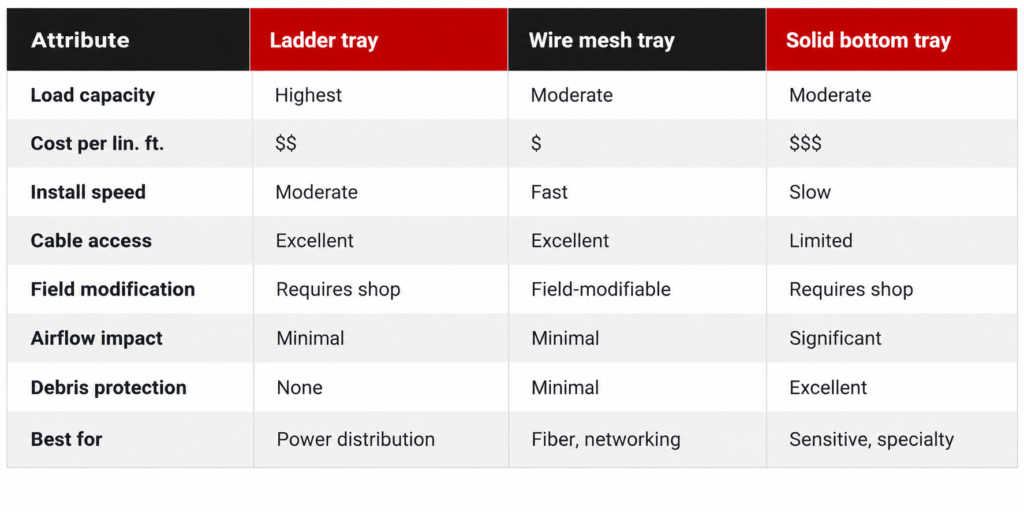
Side-by-side comparison
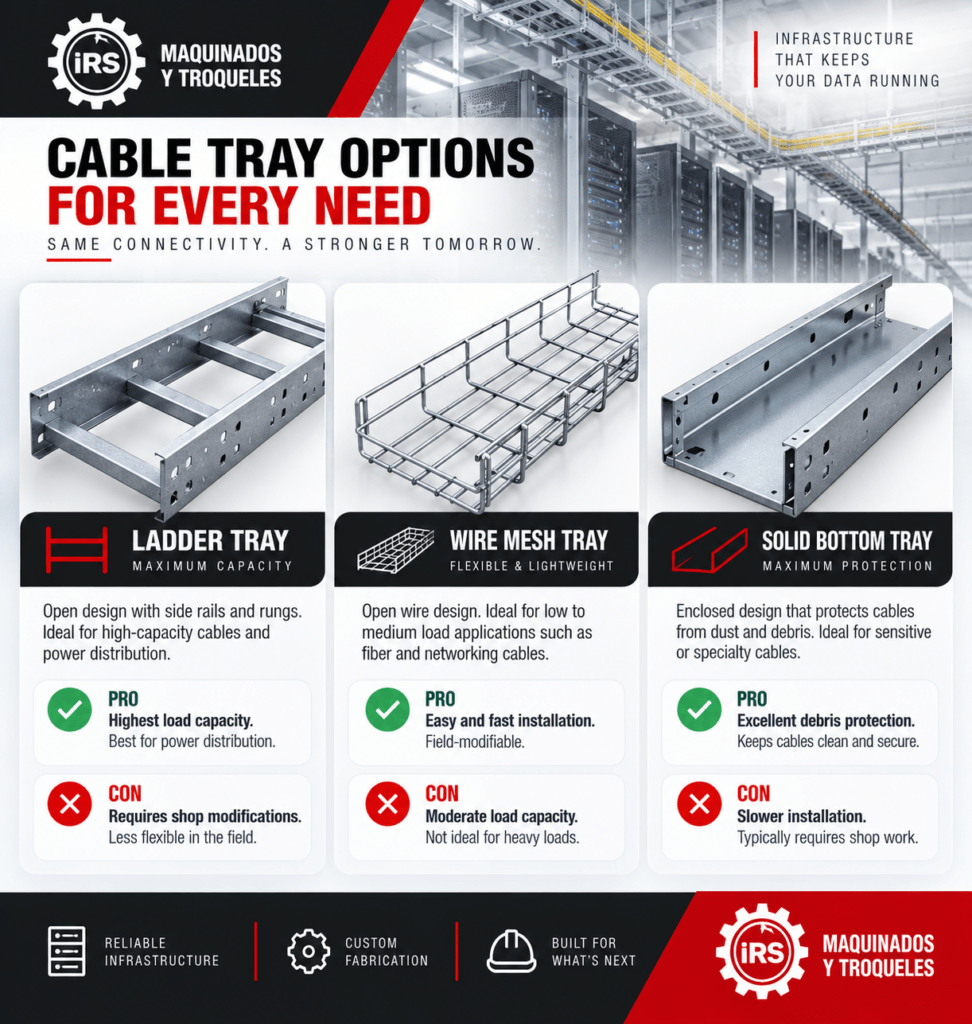
How data centers typically combine tray types
Modern data center designs rarely use a single tray type throughout. A typical layout:
- Power layer: ladder tray in the plenum for main power distribution from PDUs to rack rows.
- Data layer: wire mesh tray for fiber and structured cabling routing above server rows.
- Specialty layer: solid bottom tray for building automation and life-safety cabling where debris protection matters.
The Mexico advantage for cable tray sourcing
Custom cable tray fabricated in Mexico ships under USMCA rules of origin, avoiding tariff exposure on Chinese-manufactured tray systems that has ranged from ~25% up to 145% by category and moment. Overland freight from Nuevo León delivers to Texas data center markets in 2-3 days — faster than any offshore alternative, and often faster than domestic US manufacturers under load.
Custom cable tray fabrication: when do you need it?
For standard runs, off-the-shelf tray from major manufacturers is the fastest and lowest-cost option. Custom fabrication makes sense when:
- Non-standard sizes: custom-fabricated adapters are cheaper than modifying standard tray in the field.
- Complex geometries: tray runs matching a specific aisle layout with pre-fabricated T-junctions, reducers, and bends save field labor.
- Heavy load applications: custom seismic-rated tray systems for California or Pacific Northwest deployments.
- Integrated cable management: cable tray with pre-integrated dividers, ground straps, or PDU cutouts save field time and error.
Frequently asked questions
What is the difference between cable tray and cable ladder?
Cable ladder is one type of cable tray — the type with two parallel side rails and perpendicular rungs. Cable tray is the broader category that includes ladder, wire mesh, solid bottom, and trough types. In common usage, ‘cable tray’ often refers specifically to any of these support systems.
How much weight can a cable tray hold?
It depends on the tray type, manufacturer, and span between supports. Ladder tray supports significantly higher loads than wire mesh or solid bottom. Rated load also depends on the span between supports — shorter spans allow higher loads. Consult manufacturer load tables for the specific product.
Can you mix cable tray types in the same run?
Yes, using transition fittings. However, mixing is more common at plenum boundaries or aisle transitions than mid-run. Design intent should be documented for maintenance teams to understand why type changes occur.
What is the NEC code for cable trays?
NEC Article 392 covers cable tray systems in the US. It defines allowable fill (typically 40% of cross-sectional area for power cables), grounding requirements, and support spacing. NEC compliance is a baseline; data center specifications often add tighter requirements.