Anchoring Data Center Equipment for Seismic Loads: What US Codes Require
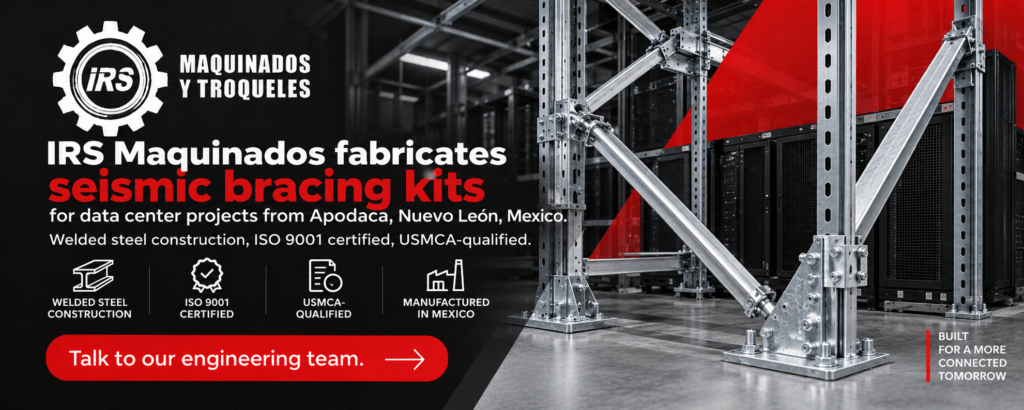
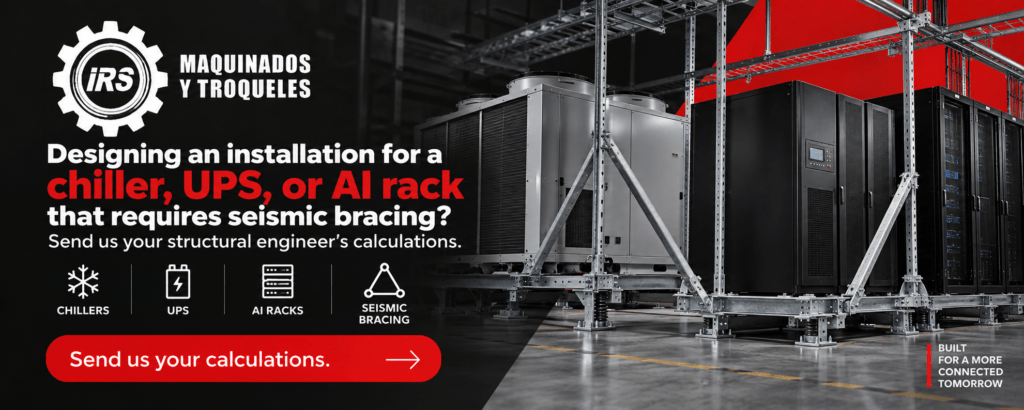
US data centers are required by IBC and ASCE 7 to anchor mechanical, electrical, and rack equipment against seismic loads. Requirements scale with (1) the building’s Seismic Design Category (A-F), (2) the equipment’s Component Importance Factor (Ip), typically 1.5 for critical data center equipment, and (3) the equipment weight and center of mass. Custom-fabricated seismic bracing manufactured in Mexico offers USMCA tariff-free delivery and 2-3 day overland transit to Texas.
Why seismic matters even in low-seismic zones
The instinct in Texas, Georgia, or Virginia is to treat seismic bracing as a California problem. That’s a mistake. Two things have changed the calculus in the last five years:
First, the International Building Code (IBC) has extended seismic anchoring requirements to essentially all jurisdictions in the US, with only the specific engineering values changing based on location. Second, data center equipment has become dramatically heavier — an AI-density server rack at 3,000+ lbs is a tipping hazard even in a mild vibration event, not just an earthquake.
The result: seismic bracing is now a standard scope item on virtually every US data center project, regardless of geographic location.
What codes govern seismic bracing for data centers?
US data centers follow: (1) IBC (International Building Code) for structural seismic requirements, (2) ASCE 7 for detailed seismic engineering including nonstructural components, (3) NFPA 75/76 for fire protection anchoring, and (4) local jurisdictional amendments. ASCE 7-22 Chapter 13 is the specific reference for equipment anchoring.
The seismic parameters that drive design
- Seismic Design Category (SDC): ranges from A (minimal seismic) to F (highest) based on site location and soil conditions.
- Component Importance Factor (Ip): a multiplier (1.0 or 1.5) applied to seismic forces. For ‘components necessary for continued operation of designated seismic systems’ — which includes data center life-safety equipment — Ip = 1.5.
- Amplification factor (ap): a factor accounting for the equipment’s inherent flexibility. Rigid equipment (like a UPS) uses ap = 1.0; flexible equipment (like tall server racks) uses ap = 2.5.
- Response modification factor (Rp): a factor for the equipment’s ductility. Welded steel structures use higher values; brittle systems use lower values.
What data center equipment requires seismic bracing?
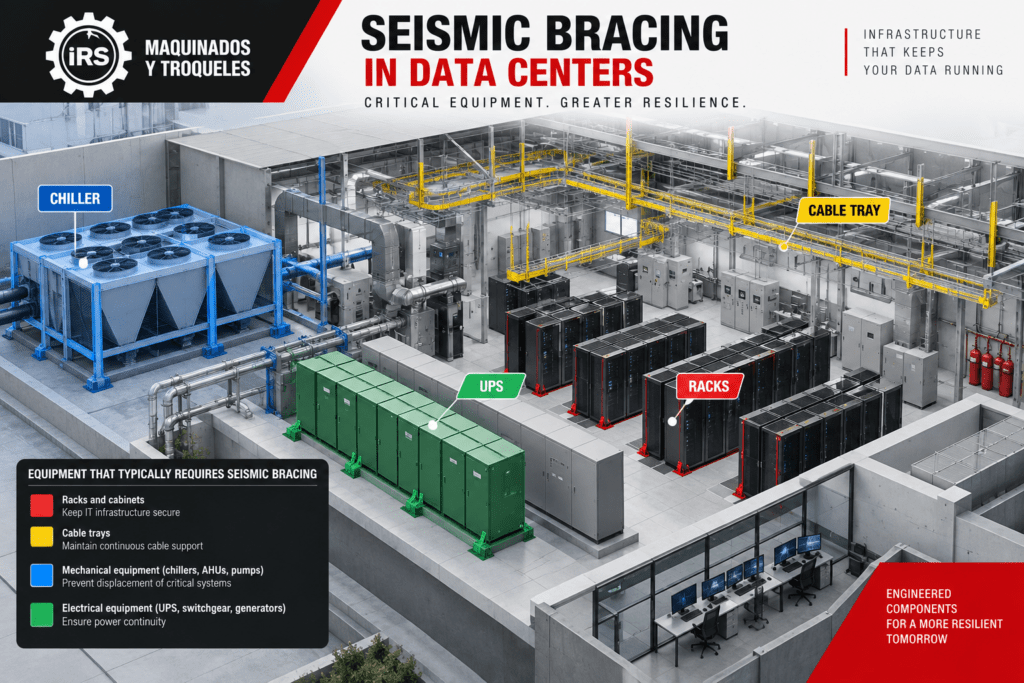
Essentially all fixed equipment above minimal size thresholds. Key categories:
Mechanical equipment
- Chillers (indoor and outdoor rooftop units).
- Cooling towers.
- Air handling units (AHUs).
- Pumps and pump skids.
- Piping systems above certain diameters.
Electrical equipment
- Uninterruptible power supplies (UPS).
- Batteries and battery racks.
- Diesel generators (indoor and outdoor).
- Transformers.
- Switchgear and PDUs.
IT equipment
- Server racks and cabinets above 400 lbs when populated.
- Network cabinets and equipment.
- Above-ceiling cable tray systems above certain fill capacities.
How is seismic bracing designed?
Seismic bracing engineering follows a repeatable framework:
Step 1: Determine seismic forces on the equipment
Using ASCE 7 Chapter 13, calculate the horizontal seismic force (Fp) on the equipment. This depends on the seismic parameters above, the equipment weight, and the height of the equipment center of mass above the base.
Step 2: Design the anchor path
Anchor the equipment through its base plate, using structural steel or engineered anchor rods, into the building slab. For roof-mounted equipment, anchor into the structural roof deck or a fabricated steel curb.
Step 3: Design bracing for tall or top-heavy equipment
For tall equipment (server racks, tall UPS cabinets, generator exhaust stacks), bracing at the top of the equipment resists overturning. Bracing typically consists of welded steel angle or square tube framework tied back to the building structure.
Step 4: Provide flexible connections
Bracing anchors the equipment; flexible connections at piping and cable interfaces prevent damage during motion. This is a paired design consideration that architects sometimes overlook.
Why manufacture seismic bracing in Mexico?
Custom seismic bracing is heavy welded steel — the exact category where Mexican manufacturing has structural advantages: (1) USMCA tariff-free treatment vs. tariffs on Chinese steel imports up to and above 145%; (2) 2-3 day overland delivery to Texas data center projects; (3) shorter iteration cycles when the structural engineer revises the seismic calc — same-timezone engineering means same-day revisions.
Custom fabrication vs. off-the-shelf seismic products
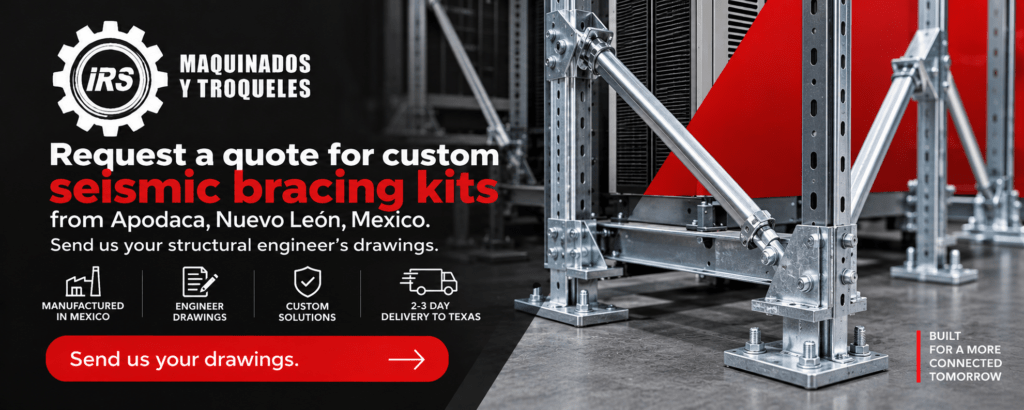
For standard equipment in standard configurations, off-the-shelf seismic anchoring products (cable-based, chain-based, or engineered strut systems) work well. Custom fabrication becomes necessary when:
- Equipment weights exceed standard product ratings: AI-density racks and modern chillers exceed the load ratings of most off-the-shelf products.
- Equipment shapes are non-standard: custom brackets and adapters connect equipment to bracing frames.
- Seismic Design Category is E or F: welded steel structural frames rated to SDC E or F requirements.
- Multiple equipment types share a common structural bay: a single custom bracing framework may serve multiple pieces of equipment more efficiently than individual off-the-shelf solutions.
Frequently asked questions
Do I need seismic bracing in low-seismic states like Texas?
Usually yes, though the engineering values are lower. IBC applies to most US jurisdictions and requires equipment anchoring calculations based on the site’s Seismic Design Category. Additionally, for heavy modern equipment like AI-density server racks, anchoring against tipping is a good practice regardless of formal code.
Who designs the seismic bracing — the equipment manufacturer or the contractor?
Typically the contractor’s Mechanical, Electrical, or Structural engineer, based on site-specific seismic parameters. The equipment manufacturer provides weight and center-of-mass data; the structural engineer designs the anchoring. The bracing fabricator builds to that design.
What is an OSHPD or DSA seismic certificate?
OSHPD (California hospitals) and DSA (California schools) require pre-approved seismic certification of equipment installations. For data centers outside those specific sectors, OSHPD/DSA aren’t required, but their engineering rigor is often used as a benchmark for critical facilities.
Can bracing be added to existing equipment, or does it need to be planned from the start?
Bracing can generally be retrofitted, though it’s cheaper and cleaner to plan from the start. Retrofits work when the equipment has accessible anchor points and the surrounding structure can accept the anchor loads. Older raised floors often cannot accept the anchor forces required by modern equipment.